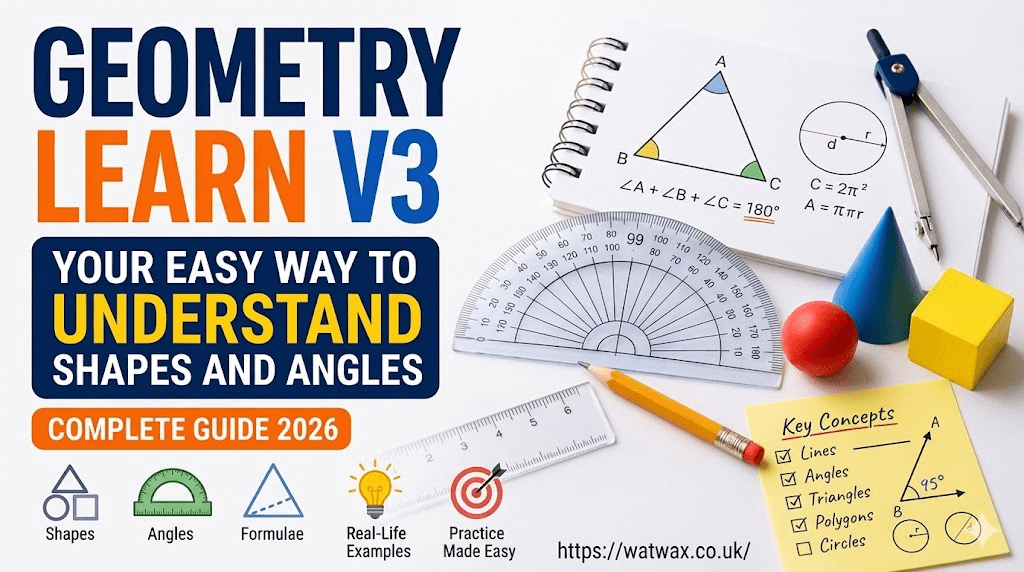
Geometry Lean V3: The Complete Beginner-to-Advanced Guide
Geometry is one of the most important branches of mathematics. It helps us understand shapes, angles, lines, distances, and space. Over the years, digital learning platforms have made geometry easier to learn. One of the names that has gained attention is Geometry Lean V3. Many students, teachers, and self-learners are searching for better ways to understand geometric concepts, and this platform aims to simplify the process.
In this guide, we will explore everything about Geometry Lean V3, including its features, benefits, learning approach, practical applications, and tips for getting the best results. Whether you are a beginner struggling with basic shapes or an advanced learner studying complex geometry, this article will help you understand how modern geometry learning tools can improve your mathematical skills.
Table of Contents
Geometry Lean V3 at a Glance
| Feature | Details |
| Name | Geometry Lean V3 |
| Category | Geometry Learning Platform |
| Purpose | Improve Geometry Understanding |
| Target Users | Students, Teachers, Self-Learners |
| Learning Style | Interactive & Visual |
| Difficulty Level | Beginner to Advanced |
| Key Focus | Shapes, Angles, Proofs, Measurements |
| Main Benefit | Better Concept Understanding |
| Learning Method | Step-by-Step Explanations |
| Practical Use | Education, Engineering, Design |
What Is Geometry Lean V3?
Geometry Lean V3 is a geometry-focused learning system designed to help users understand mathematical concepts through structured lessons and visual explanations. Geometry often becomes difficult when students rely only on memorization. This learning approach focuses on understanding why formulas work rather than simply remembering them.
The platform emphasizes visual learning, interactive problem-solving, and concept-based education. Students can explore geometric figures, relationships between angles, coordinate geometry, transformations, and proofs in a more engaging way. By breaking complex topics into smaller lessons, Geometry Lean V3 makes learning less stressful and more effective. This approach helps students build confidence and develop stronger analytical thinking skills.
Why Geometry Is Important in Everyday Life
Many people believe geometry exists only inside classrooms. In reality, geometry is everywhere. Architects use geometric principles to design buildings. Engineers rely on geometry to create bridges and machines. Artists use shapes and symmetry to create visually appealing designs.
Geometry also helps improve logical thinking and problem-solving abilities. When students learn geometry through platforms like Geometry Lean V3, they develop skills that extend beyond mathematics. These skills support careers in science, technology, engineering, architecture, graphic design, and many other fields. Understanding geometry creates a strong foundation for future academic and professional success.
Key Features of Geometry Lean V3
One reason Geometry Lean V3 attracts learners is its focus on user-friendly education. The platform typically emphasizes visual demonstrations and simplified explanations. Complex topics become easier when learners can see how concepts work in real time.
Important features may include interactive diagrams, step-by-step solutions, geometry visualization tools, practice exercises, progress tracking, and structured learning paths. These features help learners understand mathematical relationships more clearly. Instead of reading long theoretical explanations, students can interact with geometric models and gain practical understanding.
How Geometry Lean V3 Improves Learning
Traditional geometry classes sometimes move too quickly for students. As a result, many learners struggle to keep up. Geometry Lean V3 addresses this challenge by presenting information in manageable sections.
Students can review lessons multiple times, practice at their own pace, and focus on areas where they need improvement. This personalized learning experience reduces frustration and encourages continuous progress. Visual learning tools also improve memory retention because learners can connect formulas with graphical representations. The result is deeper understanding rather than short-term memorization.
Core Geometry Topics Covered
A strong geometry learning system usually includes essential mathematical concepts. These topics form the foundation of geometric knowledge.
Common topics include:
- Basic geometric shapes
- Lines and angles
- Triangles and their properties
- Circles and arcs
- Polygons
- Coordinate geometry
- Transformations
- Symmetry
- Area and perimeter
- Surface area and volume
- Geometric proofs
Learning these topics systematically helps students build confidence and progress toward more advanced mathematics.
Benefits for Students
Students gain several advantages from using Geometry Lean V3. The most important benefit is improved understanding. Instead of feeling overwhelmed by formulas, learners develop genuine comprehension of geometric relationships.
Another major advantage is increased confidence. As students solve problems independently, they become more comfortable with mathematics. Better understanding often leads to improved grades and stronger performance in exams. Interactive learning environments also keep students motivated, making study sessions more enjoyable and productive.
Benefits for Teachers
Teachers can also benefit from educational tools like Geometry Lean V3. Visual demonstrations make classroom instruction more engaging. Teachers can use diagrams and interactive examples to explain difficult concepts more effectively.
The structured learning format also saves preparation time. Teachers can focus on helping students overcome challenges rather than repeatedly explaining basic concepts. This creates a more efficient learning environment and improves classroom participation.
Geometry Lean V3 and Visual Learning
Visual learning is one of the strongest aspects of modern mathematics education. Many geometry concepts become clearer when students can see them rather than simply read about them.
Geometry Lean V3 supports visual learning through diagrams, illustrations, and graphical demonstrations. For example, students can observe how angle relationships change as lines move. They can also visualize transformations such as rotations, reflections, and translations. This hands-on experience makes abstract concepts easier to understand and remember.
Practical Applications of Geometry
Geometry is not limited to school assignments. It plays an important role in many industries and professions. Architects use geometric calculations when designing structures. Engineers rely on geometric measurements for precision and safety.
Graphic designers apply geometric principles to create balanced layouts. Video game developers use coordinate geometry to build virtual worlds. Even photographers use geometry to improve composition and perspective. Learning geometry through systems like Geometry Lean V3 can therefore provide valuable real-world skills.
Common Challenges Students Face
Many students struggle with geometry because they try to memorize formulas without understanding the concepts behind them. Others find geometric proofs difficult because they require logical reasoning.
Another challenge is visualization. Some learners find it hard to imagine shapes and spatial relationships. Geometry Lean V3 helps overcome these challenges through interactive learning methods and visual demonstrations. These tools make difficult concepts easier to grasp and apply.
Tips for Success with Geometry Lean V3
To maximize learning outcomes, students should follow a structured approach. Consistency is more important than studying for long hours occasionally.
Helpful tips include:
- Practice daily.
- Review previous lessons regularly.
- Focus on understanding concepts.
- Use visual tools whenever possible.
- Solve additional exercises.
- Take notes on key formulas.
- Learn from mistakes.
- Track your progress.
Following these strategies can significantly improve geometry performance over time.
Future of Digital Geometry Learning
The future of geometry education is becoming increasingly digital. Interactive platforms continue to evolve with advanced visualization tools, artificial intelligence, and personalized learning experiences.
Geometry Lean V3 represents the growing trend toward student-centered learning. Future developments may include adaptive learning systems, real-time feedback, virtual reality geometry environments, and AI-powered tutoring. These innovations will make geometry more accessible and engaging for learners worldwide.
Frequently Asked Questions
1. What is Geometry Lean V3?
Geometry Lean V3 is a geometry-focused learning solution designed to simplify mathematical concepts through visual and interactive learning methods.
2. Who can use Geometry Lean V3?
Students, teachers, tutors, and independent learners can benefit from Geometry Lean V3.
3. Is Geometry Lean V3 suitable for beginners?
Yes. The learning approach is designed to support beginners while also offering value for advanced learners.
4. What topics are covered in Geometry Lean V3?
Topics include shapes, angles, triangles, circles, coordinate geometry, transformations, symmetry, area, volume, and proofs.
5. How does Geometry Lean V3 improve learning?
It combines visual explanations, interactive exercises, and structured lessons to improve understanding and retention.
6. Why is geometry important?
Geometry supports problem-solving, logical reasoning, and many real-world careers including engineering, architecture, design, and technology.
Conclusion
Geometry Lean V3 offers a modern approach to learning geometry by combining visual understanding, interactive practice, and structured lessons. Instead of relying solely on memorization, learners can build genuine mathematical understanding that lasts. The platform helps students strengthen problem-solving skills, improve confidence, and connect geometry to real-world applications.
As digital education continues to evolve, tools like Geometry Lean V3 are making mathematics more accessible and engaging than ever before. Whether you are preparing for exams, teaching a class, or simply improving your skills, investing time in geometry learning can provide long-term academic and professional benefits. Start exploring geometric concepts today and discover how a deeper understanding of mathematics can open new opportunities for success.